
Showing all 4 resultsSorted by price: high to low
Oscilloscopes Singapore
Oscilloscopes for Accurate Waveform Analysis & Electrical Troubleshooting
−
See the signal. Understand the problem. Make confident measurements.
Apex Test Instruments supplies professional oscilloscopes for engineers and technicians who need to capture, display and analyse electrical signals in demanding field and industrial environments.
The SCOPIX IV range combines portable waveform measurement with isolated inputs and additional diagnostic functions. From routine electrical troubleshooting to power measurements, harmonic analysis and fieldbus diagnostics, choose an instrument that matches your required bandwidth, channel count and application.
When Basic Measurements Cannot Show You the Whole Problem
+
A multimeter can tell you the voltage at a particular moment. It cannot always show you what the signal is doing over time.
Intermittent faults, switching events, distortion, noise, unexpected pulses and communication problems can be difficult to diagnose when you cannot see the waveform. That is where an oscilloscope becomes essential.
By displaying signal voltage against time, a digital oscilloscope allows engineers to observe waveform shape and investigate behaviour that would otherwise be difficult to identify.
It can help answer questions such as:
- Is the waveform stable?
- Is electrical noise affecting the signal?
- Is the frequency correct?
- Are unexpected pulses or transients occurring?
- Is distortion present?
- Are signals properly synchronised?
- Is an industrial communication bus operating within expected electrical limits?
- How are multiple electrical signals behaving at the same time?
The result is more information for diagnosis and less dependence on assumptions.
See Electrical Behaviour as It Happens
+
For engineers working on electrical, electronic, industrial or automation systems, waveform visibility can significantly improve troubleshooting.
Professional oscilloscopes can support:
- Electrical fault diagnosis
- Waveform capture and analysis
- Signal integrity checks
- Voltage and frequency measurement
- Transient investigation
- Harmonic analysis
- Power measurements
- Industrial control troubleshooting
- Fieldbus diagnostics
- Maintenance and commissioning
- R&D and laboratory testing
- Electronics troubleshooting
Portable SCOPIX IV Oscilloscopes for Field & Engineering Applications
+
Apex Test Instruments currently offers several SCOPIX IV configurations, allowing customers to select according to channel requirements, bandwidth and diagnostic needs.
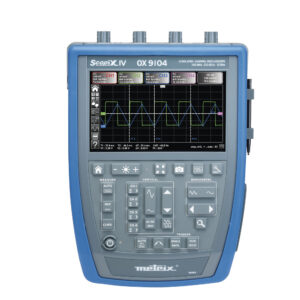
OX9104 — 4-Channel, 100 MHz Portable Oscilloscope
For applications requiring multiple simultaneous measurements, the OX9104 provides four totally isolated 600 V channels with 100 MHz bandwidth and 100 kpoints of memory per channel. Its 12-bit converter, advanced triggering, real-time FFT, harmonic analysis and power-measurement capabilities make it a versatile option for demanding electrical diagnostics. It also incorporates multimeter and logger functions, helping reduce the number of separate instruments required for certain field measurement tasks.
Suitable for: Multi-channel troubleshooting, industrial maintenance, power electronics, electrical measurements and advanced field diagnostics.
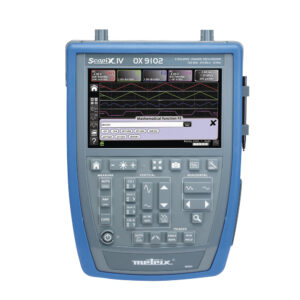
OX9102 — 2-Channel, 100 MHz Portable Oscilloscope
The OX9102 provides two totally isolated 600 V channels, 100 MHz bandwidth and 100 kpoints of memory per channel. It combines oscilloscope functionality with FFT analysis, harmonics, power measurements, digital multimeter functions and data logging. For applications that need high-performance waveform analysis without requiring four measurement channels, the OX9102 provides a practical configuration.
Suitable for: Electrical troubleshooting, electronic signals, power measurements, maintenance and field diagnostics.
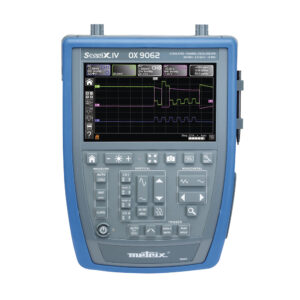
OX9062 — 2-Channel, 60 MHz Portable Oscilloscope
The OX9062 features two totally isolated 600 V channels with 60 MHz bandwidth. It uses a 12-bit converter and includes automatic measurements, mathematical functions, FFT, harmonic analysis, multimeter functionality and logging capabilities. The instrument also offers a one-shot sampling rate of up to 2.5 GS/s and battery operation for portable field measurement.
Suitable for: General electrical troubleshooting, industrial maintenance, field testing and applications where 60 MHz bandwidth meets the measurement requirement.
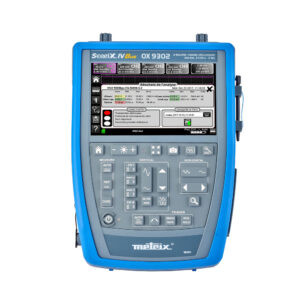
OX9302-BUS — Fieldbus Diagnostic Oscilloscope
Modern industrial systems increasingly depend on communication networks as well as electrical power. The OX9302-BUS is designed to help assess the electrical integrity of industrial fieldbuses and the operation of their physical layers.
Supported protocols: CAN, LIN, KNX, DALI, AS-i, Profibus, RS-485, RS-232, Ethernet.
The system guides users through bus selection, measurement tolerances, analysis and diagnostic results.
Suitable for: Industrial automation, communication-bus troubleshooting, commissioning and maintenance of connected equipment.
Why Isolated Oscilloscope Inputs Matter
+
Measuring signals in industrial electrical systems can be very different from testing low-voltage electronics on a laboratory bench. Conventional oscilloscope channel grounds may share a common reference. This requires careful consideration when measuring floating or differently referenced circuits.
An oscilloscope with independently isolated input channels is specifically designed to support floating measurements without forcing all channel references to the same common potential.
This can be particularly useful when investigating:
- Power electronics
- Motor drives
- Inverters
- Industrial control circuits
- Power supplies
- Electrical installations
- Differently referenced signals
The OX9104, OX9102 and OX9062 offered by Apex feature isolated 600 V input channels.
How to Choose the Right Oscilloscope
+
The highest specification is not automatically the best choice. A suitable instrument should match the signals you actually need to measure.
1. Consider Bandwidth
Bandwidth determines the frequency range an oscilloscope can measure effectively. Your instrument needs enough bandwidth to reproduce the important frequency components of the signal without excessive attenuation. For the current Apex range, options include 60 MHz and 100 MHz configurations.
2. Choose the Required Number of Channels
Ask how many signals need to be viewed simultaneously. A two-channel instrument may be sufficient for many troubleshooting tasks, while applications involving multiple signals may benefit from a four-channel model.
3. Check Isolation Requirements
If measurements involve floating voltages, power electronics or differently referenced circuits, channel isolation can be an important selection factor.
4. Look at Sampling Rate
Sampling rate determines how frequently the oscilloscope takes measurements of the incoming signal. Higher-speed signals generally require an appropriately high sampling rate to capture useful waveform detail.
5. Consider More Than Waveform Display
Depending on your work, additional capabilities may reduce the need for separate instruments. The SCOPIX IV models offered by Apex can provide functions including:
- TRMS multimeter measurements
- Data logging
- FFT analysis
- Harmonic analysis
- Power measurements
- Automatic waveform measurements
- Mathematical functions
- Remote communication
6. Match the Instrument to the Application
If the main requirement is industrial communication troubleshooting, a fieldbus diagnostic solution such as the OX9302-BUS may be more appropriate than choosing an instrument based only on bandwidth.
Why Choose Apex Test Instruments?
+
Professional test equipment should come with more than a datasheet. Apex Test Instruments supports customers with product and applications knowledge before and after purchase.
20+ Years of Test & Measurement Experience
Apex states that its key management team has more than 20 years of experience in the Test & Measurement industry, providing a strong technical foundation for product selection and customer support.
Technical & Applications Knowledge
Apex identifies technical and applications knowledge for pre-sales and post-sales support as one of its core strengths. This can be particularly valuable when oscilloscope selection depends on signal type, voltage, bandwidth, isolation, channel count and the environment in which the instrument will be used.
Professional Measurement Solutions
The available range covers portable oscilloscopes designed for industrial and field measurements, including models with isolated channels, waveform analysis, multimeter functionality, harmonic analysis, power measurements and fieldbus diagnostics.
Calibration Support in Singapore
Apex Test Instruments collaborates with an Accredited Calibration Laboratory in Singapore to provide calibration support for customers with test and measurement requirements.
Southeast Asia Industry Network
Apex states that it has developed relationships and Test & Measurement distribution networks across Southeast Asia, alongside relationships with equipment principals and customers.
Not Sure Which Model You Need? Before requesting a quote, tell our team:
- What are you measuring? (Voltage, electronic signals, power circuits or communication buses?)
- What frequency range is involved?
- How many channels do you need?
- Do you need isolated inputs?
- Will the instrument be used mainly in the field or laboratory?
- Do you require harmonics, power, logging or fieldbus functions?
Providing these details helps narrow down the most appropriate instrument without paying for specifications your application does not require.
Frequently Asked Questions About Oscilloscopes
+
What is an oscilloscope used for?
An oscilloscope displays how an electrical signal changes over time. Engineers use it to measure and analyse waveform shape, voltage, frequency, timing, noise, distortion, pulses and transient events when troubleshooting electrical and electronic systems.
What bandwidth oscilloscope do I need?
Choose an oscilloscope with bandwidth comfortably above the highest-frequency content you need to measure. Bandwidth affects how accurately higher-frequency signals and fast waveform edges can be reproduced, so the correct specification depends on the application rather than simply choosing the highest available value.
What is the difference between a 2-channel and 4-channel oscilloscope?
A 2-channel oscilloscope can display two input signals simultaneously, while a 4-channel oscilloscope can analyse four. Four channels are useful when troubleshooting systems where several related signals need to be compared at the same time.
What is an isolated oscilloscope?
An isolated oscilloscope has input channels electrically isolated from one another and/or ground, depending on its design. This allows suitable models to perform floating measurements in applications such as power electronics and industrial electrical systems where conventional common-ground oscilloscope connections may not be appropriate.
See the Signal Before You Replace the Wrong Component
+
Intermittent faults are difficult to solve when you cannot see what is happening electrically.
The right oscilloscope gives engineers a clearer view of signal behaviour, allowing them to identify abnormalities, compare channels and gather evidence before making a troubleshooting decision.
Whether you need a portable digital oscilloscope, isolated oscilloscope, 2-channel or 4-channel scope, power-analysis capability or fieldbus diagnostics, Apex Test Instruments can help you select a model suited to the application.
Tell us what you need to measure. We’ll help you narrow down the right instrument.